
Proposal: Time to Touch Grass? A Personalized Cost-Benefit Analysis of Internet Use
Cultural Science, Study Proposal #1

Some people are frustrated with their online habits, while others feel unconcerned, or even genuinely satisfied with the access to information and entertainment that the online world offers.
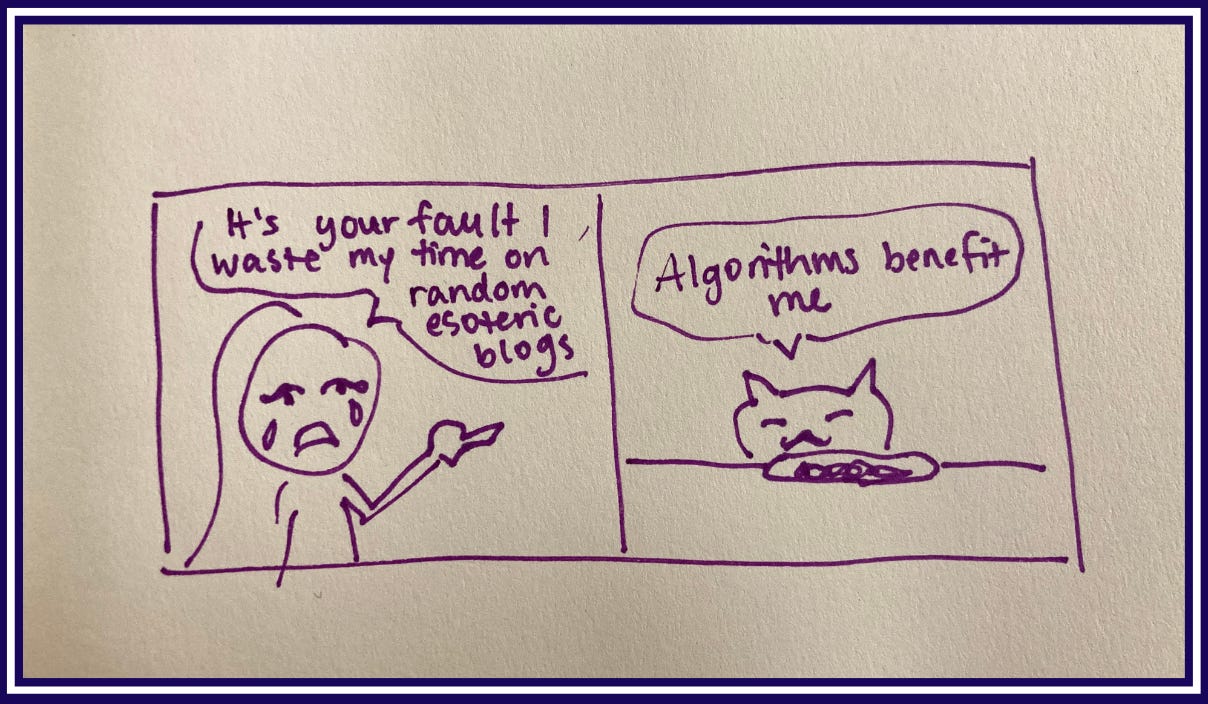
You may have wondered if your online addictions are the source of some of your problems. You may have considered quitting. But then you ask yourself,
How would I get the news? How would I stay up to date with my industry? How would I stay in touch with some of my social groups? What if I need to sell something on Facebook marketplace?
I’m always hearing about great business opportunities from X / recipes from TikTok / decor ideas from Pinterest / [insert your interest] from [insert your platform]. And actually, the humor of memes is truly joyous at times.
The truth is that these benefits, and others, are real. The question is whether the benefits exceed the costs. This is a highly individual question, since people use the internet in different ways, so studying the effects of “social media use” is not really studying one thing.
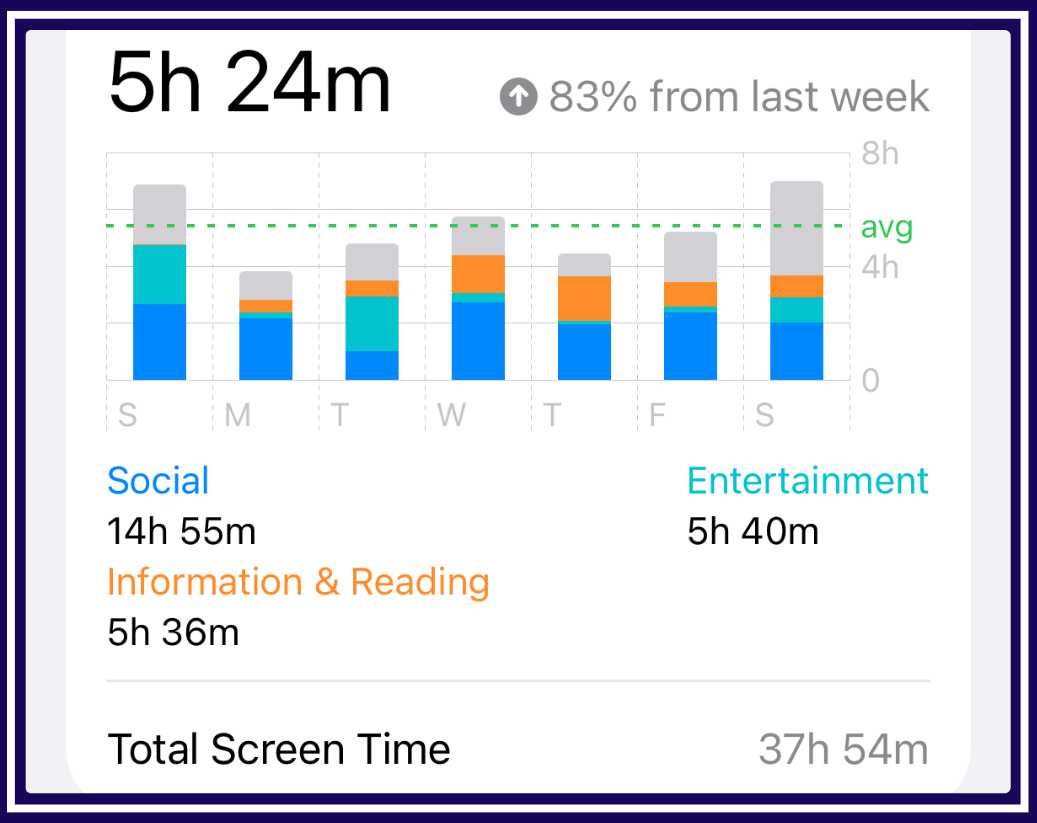
It could be that, although you hear about a cool event once in a while, you mostly spend hours consuming rage bait. Or it could be that your feed primarily inspires you to achieve your goals and learn from others who share them. It’s hard to have an accurate picture of what you really do during your time online, and how it affects you.
Does internet use generally cause harm, or is it the way we use it that is to blame for any harms it may cause?
Is there a better way that we can be online, reaping more benefits and fewer costs? Or is it more appropriate to remove your presence? How does any of this advice apply to you and your habits?
What we know
The experts do not at all agree.
For example, different researchers have come to different conclusions about whether phone use is at all associated with increased risk of depression and anxiety in teens. In one case, two sets of researchers found very different results by analyzing the same dataset with different methods, and they had a little back and forth about it in the journal Nature Human Behavior (Orben & Przybylski, 2019; Twenge & Haidt et al, 2020; Orben & Przybylski, 2020). One of the researchers, Jonathan Haidt, is the author of The Anxious Generation, and frequently publicly argues that phones have caused a teen mental health epidemic.
But inferring causality is particularly hard for this topic. Even if there is an association, it’s hard to say whether phone use causes depression or if more depressed teens turn to their phones (Odgers, 2024). Also, sometimes the associations are positive, like increased feelings of community connectedness for LGBTQ youth (Berger et al, 2022) or even enjoyment and increased well-being for those who are less susceptible to envy (Verduyn et al, 2017; Valkenburg et al, 2022).
If social media were bad, you’d expect abstaining from it would increase happiness and life satisfaction in some way, but this is surprisingly not the case across multiple studies (Lemahieu et al, 2025). On the other hand, a quasi-experimental analysis of Facebook’s rollout at colleges found negative causal effects on students’ mental health (Braghieri et al, 2022).
We also must note that time spent online can mean extremely different things. Collapsing all of online behavior into a variable of “hours spent per day” is losing too much nuance. There aren’t many studies that analyze highly specific differentiations.
Clearly the true story is complicated, and we haven’t figured it out yet.
In order to get a useful takeaway, we need to distinguish for which individuals and what type of usage is harmful or beneficial.
What we don’t know
What are the meaningful categorizations of online behavior? Is it the platform, the content type, or your style of interaction with it?
What are the main benefits and harms, and how do they differ between people?
And most practically: how do you figure out whether your own usage is working for you?
Study Design
This is an exploratory study. We aim to quantify and categorize internet use and the way individuals feel around it. For example:
What subcultures are you engaging with?
How much of your content encourages social comparison?
Are you consuming content from strangers and public figures or are you interacting with people you actually know?
How adversarial is the space you’re in?
Is the content about real events or entertainment?
Is your usage intentional, where you sought something specific out, or algorithmically driven, where you opened one thing and ended up somewhere else entirely?
We want this to be a meaningful experience for each individual participant. We will provide each participant with a personal dashboard of their own internet use and how it correlates with how they feel. You will observe your own behavior, learn about your habits, and gain awareness about how your online time does or does not align with your goals.
These questions require a new kind of data to answer.
A New Data Collection Tool
In a previous study which produced some of the best individual-level data in the literature, participants were surveyed 6 times per day, answering how much they had used social media in the past hour and their present mood (Valkenburg et al, 2022). This generated enough data to demonstrate that effects vary dramatically between individuals. But they still relied on self-reported usage estimates, and didn’t capture what the participants specifically were doing online.
More recent work has begun to address this. The Human Screenome Project at Stanford University has developed an open-source platform that captures screenshots from participants’ smartphones every few seconds during active use. This “screenomics” approach represents a significant methodological advance over self-report.
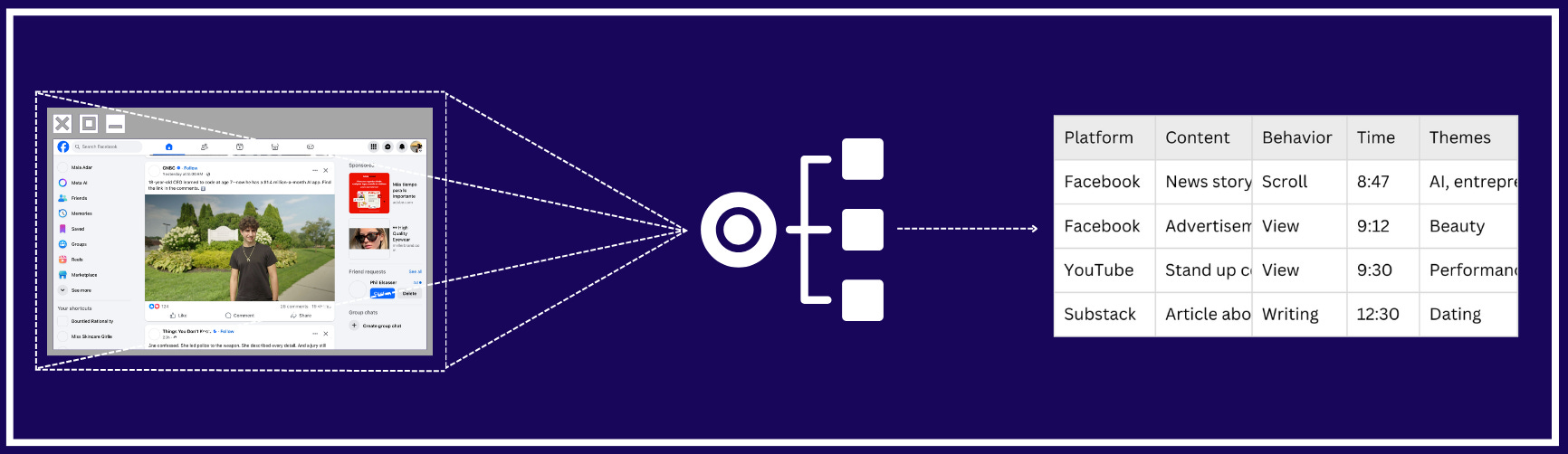
Our study will extend this innovation, both by building a complementary browser extension to get more complete internet use coverage, and by adding an AI classification layer to categorize content in real time, with raw screenshots discarded immediately and only structured classifications retained. This will allow us to automatically track online behavior objectively and in granular detail.
The tool has two-parts: a mobile app and a browser extension, working together to passively capture leisure screen time across both phone and computer. Every 30 seconds during active use, a screenshot is taken and classifies the content by platform, content type, and behavior type. The raw screenshot is immediately discarded and only structured data of the classifications is retained.
Privacy must be a core design principle. The user must have full control over when tracking can occur. By default, the tool only collects on leisure apps or sites (i.e. blocked from banking apps, health portals, etc). Participation is entirely opt-in, participants are fully aware of what is being collected, and they can easily pause or stop tracking at any time.
This is paired with brief mood check-ins timed to capture the arc of each session: one before, one immediately after, and one delayed by a couple of hours to catch any effects that don’t show up right away. Together, these data points allow us to move closer to causal inference, e.g. if someone consistently enters a session neutral and exits feeling worse, that pattern suggests an effect (Hill, 1965). All check-ins must be very short so that they do not become tedious, with optional space for additional notes.
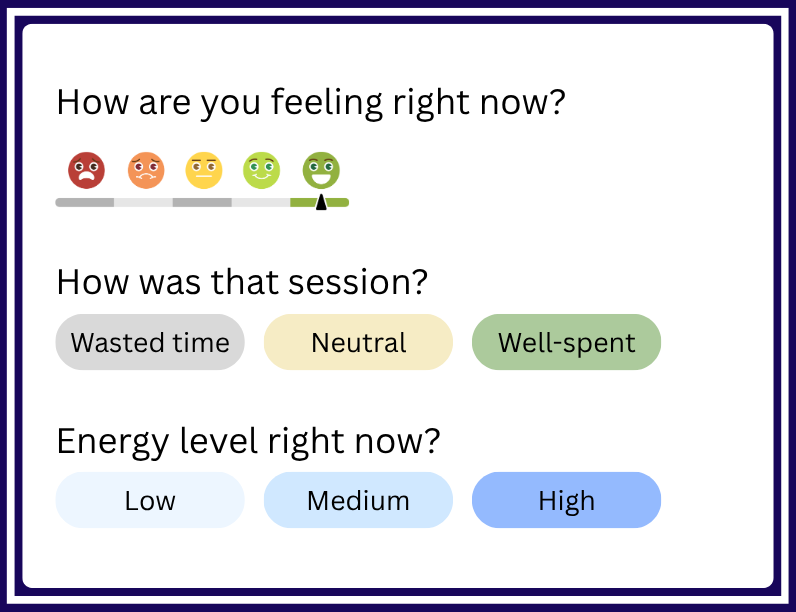
The result is the kind of granular, objective, individual-level data that can answer our questions.
How We’ll Analyze
Participants will receive a personal dashboard showing a summary of their individual results. What aspects of your online behavior result in the most positive or negative impact on your mood? Do the patterns in your data match what you believe about yourself? The goal is that by the end of the study, each participant gains awareness about their own online habits than they had before.
At the population level, we’ll look across participants to identify broader patterns. Are there types of online behavior that tend to harm or benefit most people? Are there groups who tend to respond differently (e.g. developmental stage, gender, baseline personality traits)? These will contribute to the existing literature in a more granular way.
Sample size depends on what we’re trying to learn. For the individual dashboards to be meaningful, each participant needs enough sessions to detect their own patterns, at least 4 weeks or so. For population-level analysis with enough power to say something about subgroups, we’re targeting around 150-200 participants. Final numbers will be determined based on the specific design selected.
How much would it cost?
This study would require a higher upfront investment than our typical research projects due to the development of the data collection tool. However, this tool is very valuable beyond the study itself, as a product that could be used for future research, licensed to other institutions, or offered directly to consumers interested in understanding their own online habits.
We estimate the total cost at approximately $150-250k, depending on the final study design. This breaks down into tool development (~$100-150k, a one-time cost) and study execution (~$50-100k, covering participant recruitment and incentives, data management, and administration). As with our previous studies, we are able to keep execution costs lean due to our existing infrastructure, hands-on experience with consumer research, and freedom from institutional overhead.
The final scope and cost would be determined together with the patron.
What the results would mean
The most valuable outcome of this study is a personalized one. For each participant, the data could generate a specific, evidence-based picture of how their own internet use affects them, and actionable guidance on what to do about it.
Is there some platform that I should just completely delete (e.g. X makes my ending mood worse 80% of the time)? Does a particular type of content stand out as reliably positive (e.g. physics videos, cooking tutorials)? Do I need time limits on certain apps (e.g. sessions less than 15 minutes increase mood, longer tends to decrease mood)?
And at the population level, consistent patterns across participants would contribute granular, objective evidence about which specific types of online behavior tend to help or harm. Existing research has been able to tell us that effects vary, but this research could move us closer to understanding how and why.
The ultimate goal is to give people better information about a decision they’re already making every day.
What are your experiences with internet use? What do you think would be the result of this study? Where could it be improved? We’d love to hear your feedback.
You can also contact us at info@cosimoresearch.com.